Uses WhiteStripe indices to create image mask
whitestripe_ind_to_mask(img, indices, writeimg = FALSE, ...)Arguments
- img
Array or class nifti that is corresponds to dimensions of the images the indices were generated from
- indices
indices from
whitestripe- writeimg
logical to write image or not
- ...
arguments to passed to
writeNIfTIfor writing image
Value
Class of array or nifti depending on img input
See also
whitestripe, whitestripe_hybrid
Examples
# \donttest{
lib.loc = tempdir()
if (download_img_data(lib.loc = lib.loc)){
t1 = oro.nifti::readNIfTI(system.file("T1Strip.nii.gz",
package="WhiteStripe",
lib.loc = lib.loc))
t2 = oro.nifti::readNIfTI(system.file("T2Strip.nii.gz",
package="WhiteStripe",
lib.loc = lib.loc))
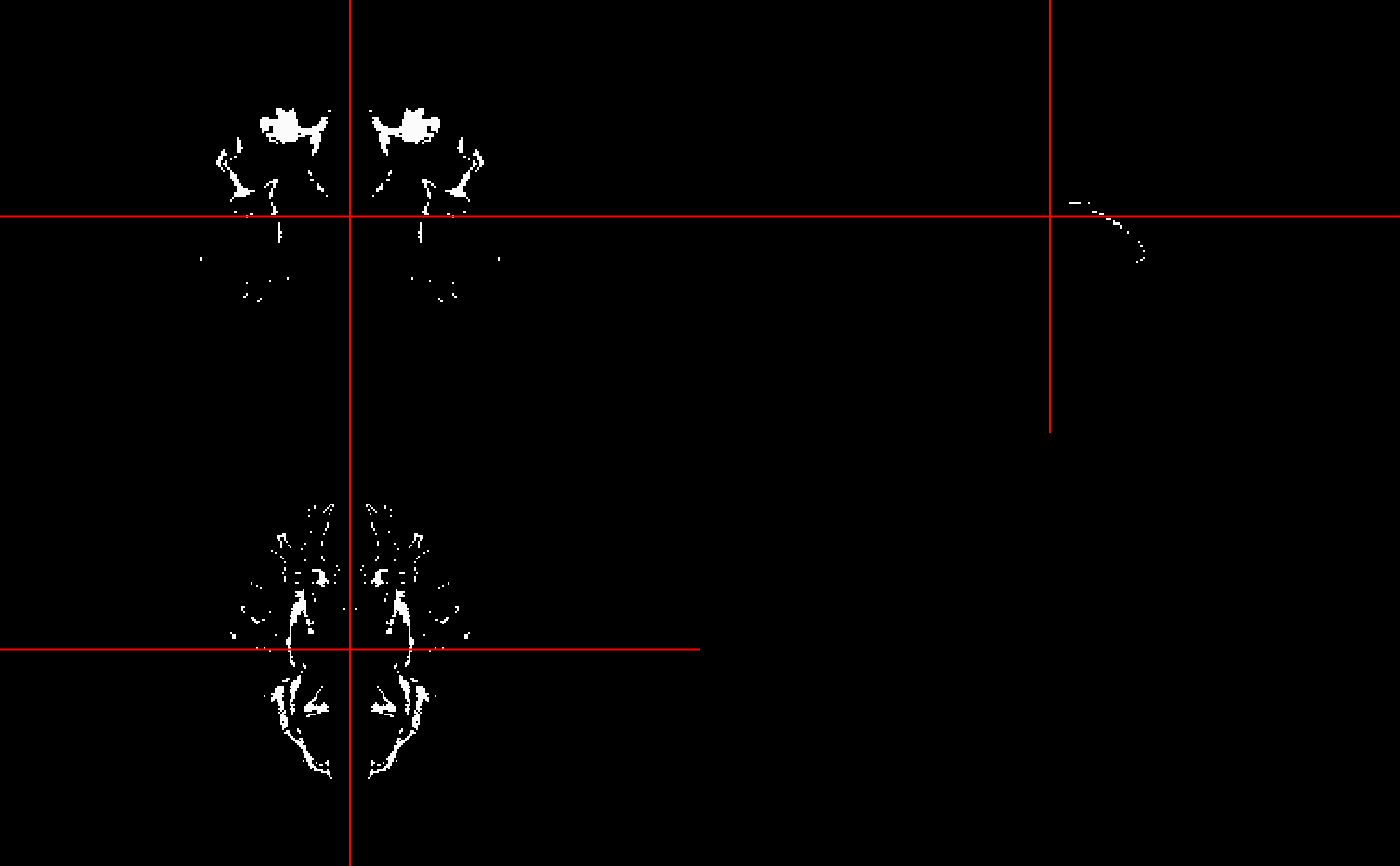
ind = whitestripe_hybrid(t1, t2)
mask = whitestripe_ind_to_mask(t1, ind$whitestripe.ind)
oro.nifti::orthographic(mask)
}
#> Making Image VOI
#> Using all slices of the image as slices not defined! Use stripped = TRUE if using skull-stripped images.
#> Making T1 Histogram
#> Getting T1 Modes
#> Smoothing Histogram
#> Smoothing Derivative
#> Quantile T1 VOI
#> Making Image VOI
#> Using all slices of the image as slices not defined! Use stripped = TRUE if using skull-stripped images.
#> Making T2 Histogram
#> Getting T2 Modes
#> Smoothing Histogram
#> Smoothing Derivative
#> Quantile T2 VOI
 # }