Adaptive smoothing of ESTATICS parameters and MPM data
smoothESTATICS.RdPerforms adaptive smoothing of parameter maps in the ESTATICS model and if
mpmData is specified these data. Implements both vectorized variants of the
Adaptive Weights Smoothing (AWS, Polzehl and Spokoiny (2006))
and patchwise AWS (PAWS, Polzehl et al (2018)) algorithms with weighting schemes determined by
the estimated parameter maps and their covariances.
smoothESTATICS(mpmESTATICSModel, mpmData = NULL, kstar = 16, alpha = 0.025,
               patchsize = 0, mscbw =5, wghts = NULL, verbose = TRUE)
Arguments
- mpmESTATICSModel
Object of class 'ESTATICSModel' as returned from function
estimateESTATICS.- mpmData
(optional) Object of class MPMData as created by
readMPMDatafrom which the parameter maps were obtained.- kstar
Maximum number of steps.
- alpha
specifies the scale parameter for the adaptation criterion. smaller values are more restrictive.
- patchsize
Patchsize in PAWS, 0 corresponds to AWS, alternative values are 1 and 2.
- mscbw
bandwidth for 3D median smoother used to stabilize the covariance estimates.
- wghts
(optional) voxel size if measurments are not isotropic.
- verbose
logical - provide information on progress
Value
list with components
- modelCoeff
Estimated parameter maps
- invCov
map of inverse covariance matrices
- isConv
convergence indicator map
- bi
Sum of weights map from AWS/PAWS
- smoothPar
smooting parameters used in AWS/PAWS
- smoothedData
smoothed mpmData
- sdim
image dimension
- nFiles
number of images
- t1Files
vector of T1 filenames
- pdFiles
vector of PD filenames
- mtFiles
vector of MT filenames
- model
model used (depends on specification of MT files)
- maskFile
filename of brain mask
- mask
brain mask
- sigma
sigma
- L
L
- TR
TR values
- TE
TE values
- FA
Flip angles (FA)
- TEScale
TEScale
- dataScale
dataScale
and class-attribute 'sESTATICSModel'
References
J. Polzehl, V. Spokoiny, Propagation-separation approach for local likelihood estimation, Probab. Theory Related Fields 135 (3), (2006) , pp. 335–362.
J. Polzehl, K. Papafitsorus, K. Tabelow (2018). Patch-wise adaptive weights smoothing. WIAS-Preprint 2520.
J. Polzehl and K. Tabelow (2023), Magnetic Resonance Brain Imaging: Modeling and Data Analysis Using R, 2nd Edition, Chapter 6, Springer, Use R! Series. <doi:10.1007/978-3-031-38949-8_6>.
J. Polzehl and K. Tabelow (2023), Magnetic Resonance Brain Imaging - Modeling and Data Analysis Using R: Code and Data. <doi:10.20347/WIAS.DATA.6>.
See also
Examples
# \donttest{
dataDir <- system.file("extdata",package="qMRI")
#
# set file names for T1w, MTw and PDw images
#
t1Names <- paste0("t1w_",1:8,".nii.gz")
mtNames <- paste0("mtw_",1:6,".nii.gz")
pdNames <- paste0("pdw_",1:8,".nii.gz")
t1Files <- file.path(dataDir, t1Names)
mtFiles <- file.path(dataDir, mtNames)
pdFiles <- file.path(dataDir, pdNames)
#
# file names of mask and B1 field map
#
B1File <- file.path(dataDir, "B1map.nii.gz")
maskFile <- file.path(dataDir, "mask.nii.gz")
#
# Acquisition parameters (TE, TR, Flip Angle) for T1w, MTw and PDw images
#
TE <- c(2.3, 4.6, 6.9, 9.2, 11.5, 13.8, 16.1, 18.4,
2.3, 4.6, 6.9, 9.2, 11.5, 13.8,
2.3, 4.6, 6.9, 9.2, 11.5, 13.8, 16.1, 18.4)
TR <- rep(25, 22)
FA <- c(rep(21, 8), rep(6, 6), rep(6, 8))
#
# read MPM example data
#
library(qMRI)
mpm <- readMPMData(t1Files, pdFiles, mtFiles,
maskFile, TR = TR, TE = TE,
FA = FA, verbose = FALSE)
#
# Estimate Parameters in the ESTATICS model
#
modelMPM <- estimateESTATICS(mpm, method = "NLR")
#> Design of the model:
#> [,1] [,2] [,3] [,4]
#> [1,] 1 0 0 0.023
#> [2,] 1 0 0 0.046
#> [3,] 1 0 0 0.069
#> [4,] 1 0 0 0.092
#> [5,] 1 0 0 0.115
#> [6,] 1 0 0 0.138
#> [7,] 1 0 0 0.161
#> [8,] 1 0 0 0.184
#> [9,] 0 1 0 0.023
#> [10,] 0 1 0 0.046
#> [11,] 0 1 0 0.069
#> [12,] 0 1 0 0.092
#> [13,] 0 1 0 0.115
#> [14,] 0 1 0 0.138
#> [15,] 0 0 1 0.023
#> [16,] 0 0 1 0.046
#> [17,] 0 0 1 0.069
#> [18,] 0 0 1 0.092
#> [19,] 0 0 1 0.115
#> [20,] 0 0 1 0.138
#> [21,] 0 0 1 0.161
#> [22,] 0 0 1 0.184
#> done
#> Start estimation in 11200 voxel at 2025-06-09 19:24:18
#> Total CPU cores available: 4 CPU cores in use: 2.
#> Total CPU cores available: 4 CPU cores in use: 2.
#> Finished estimation 2025-06-09 19:24:25
#
# smooth maps of ESTATICS Parameters
#
setCores(2)
#> Total CPU cores available: 4 CPU cores in use: 2.
modelMPMsp1 <- smoothESTATICS(modelMPM,
kstar = 16,
alpha = 0.004,
patchsize=1,
verbose = TRUE)
#> using lambda= 125.0501 patchsize= 1
#> Progress:step 1 hakt 1.010096 time 2025-06-09 19:24:25
#> 0.72% mean(bi) 1.11 step 2 hakt 1.022114 time 2025-06-09 19:24:25
#> 1.6% mean(bi) 1.23 step 3 hakt 1.036736 time 2025-06-09 19:24:25
#> 2.8% mean(bi) 1.37 step 4 hakt 1.055091 time 2025-06-09 19:24:25
#> 4.2% mean(bi) 1.55 step 5 hakt 1.079247 time 2025-06-09 19:24:25
#> 5.9% mean(bi) 1.76 step 6 hakt 1.113579 time 2025-06-09 19:24:25
#> 8.2% mean(bi) 2.05 step 7 hakt 1.169869 time 2025-06-09 19:24:26
#> 11% mean(bi) 2.47 step 8 hakt 1.301844 time 2025-06-09 19:24:26
#> 14% mean(bi) 3.24 step 9 hakt 1.432987 time 2025-06-09 19:24:26
#> 19% mean(bi) 4.05 step 10 hakt 1.46909 time 2025-06-09 19:24:26
#> 24% mean(bi) 4.64 step 11 hakt 1.523812 time 2025-06-09 19:24:26
#> 31% mean(bi) 5.46 step 12 hakt 1.627073 time 2025-06-09 19:24:26
#> 39% mean(bi) 6.78 step 13 hakt 1.781336 time 2025-06-09 19:24:26
#> 50% mean(bi) 8.65 step 14 hakt 1.97111 time 2025-06-09 19:24:26
#> 63% mean(bi) 11.1 step 15 hakt 2.236947 time 2025-06-09 19:24:27
#> 79% mean(bi) 14.4 step 16 hakt 2.333957 time 2025-06-09 19:24:27
#> 100% mean(bi) 16.7
#
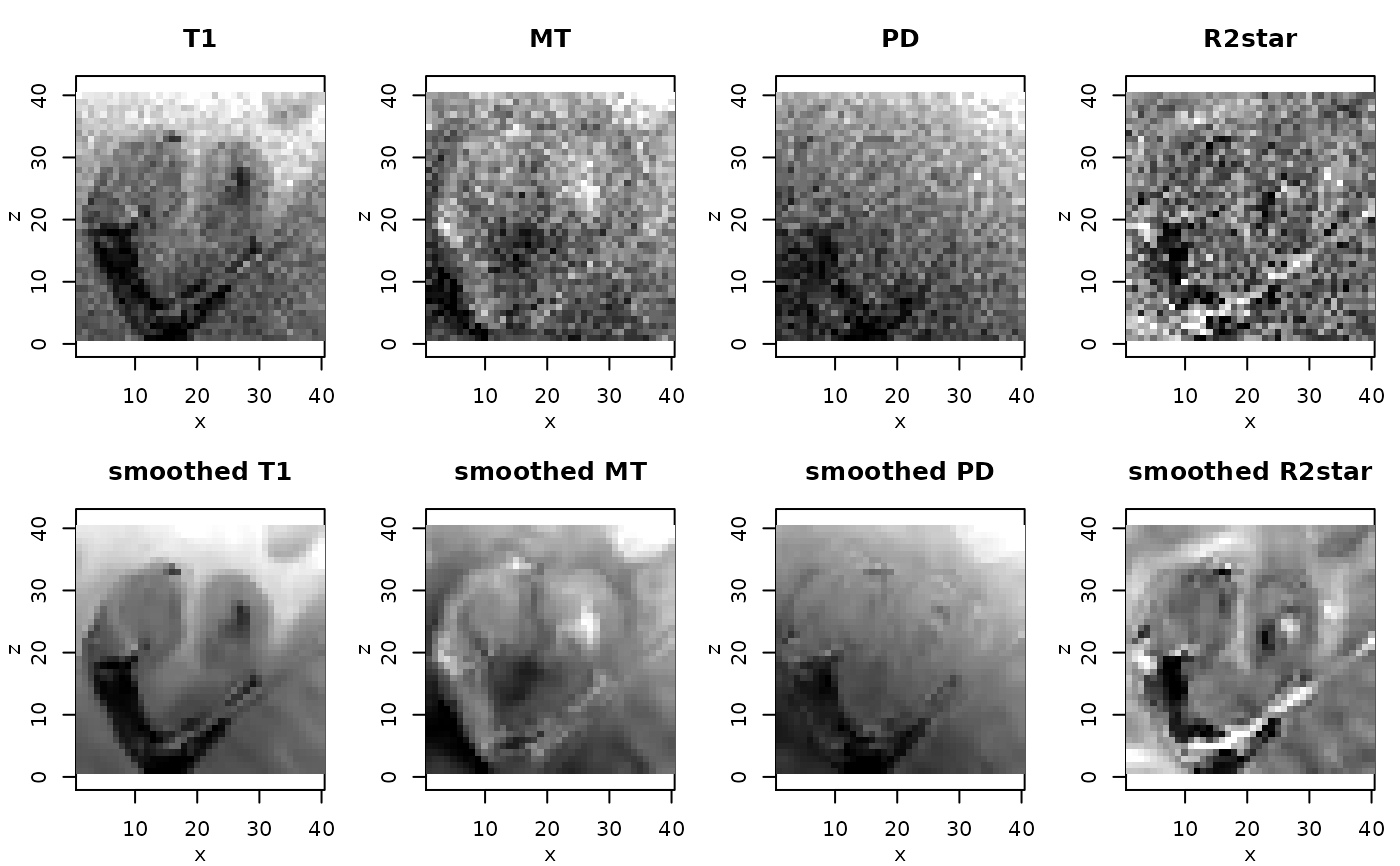
# resulting ESTATICS parameter maps for central coronal slice
#
if(require(adimpro)){
rimage.options(zquantiles=c(.01,.99), ylab="z")
oldpar <- par(mfrow=c(2,4),mar=c(3,3,3,1),mgp=c(2,1,0))
on.exit(par(oldpar))
pnames <- c("T1","MT","PD","R2star")
modelCoeff <- extract(modelMPM,"modelCoeff")
for(i in 1:4){
rimage(modelCoeff[i,,11,])
title(pnames[i])
}
modelCoeff <- extract(modelMPMsp1,"modelCoeff")
for(i in 1:4){
rimage(modelCoeff[i,,11,])
title(paste("smoothed",pnames[i]))
}
}
 par(oldpar)
# }